
The manufacturing landscape in India has undergone a dramatic transformation. With over 70% of B2B clients now initiating their buying process with an online search, manufacturers can no longer rely solely on traditional relationship-based selling. This shift has created an urgent need for specialized marketing expertise, making the selection of the right B2B Marketing Agency a critical business decision.
Selecting the right B2B Marketing Agency can transform your manufacturing business’s growth trajectory, while the wrong choice can cost both time and revenue. The challenge lies in navigating a crowded marketplace where agencies make bold promises but few deliver measurable results for the manufacturing sector.
This guide provides a data-driven framework for evaluating potential agency partners, helping you avoid costly mistakes and find an agency that truly understands the complexities of B2B manufacturing marketing in India.
Why Choosing the Right Agency Matters More Than Ever
The stakes for agency selection have never been higher. Research reveals that 71% of B2B companies lack complete attribution of marketing touchpoints to revenue, highlighting how critical it is to partner with agencies that understand sophisticated measurement and attribution.
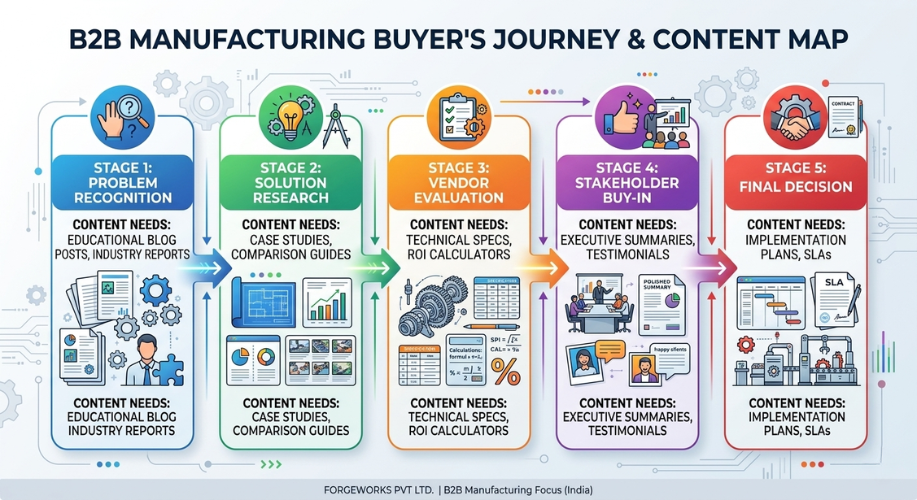
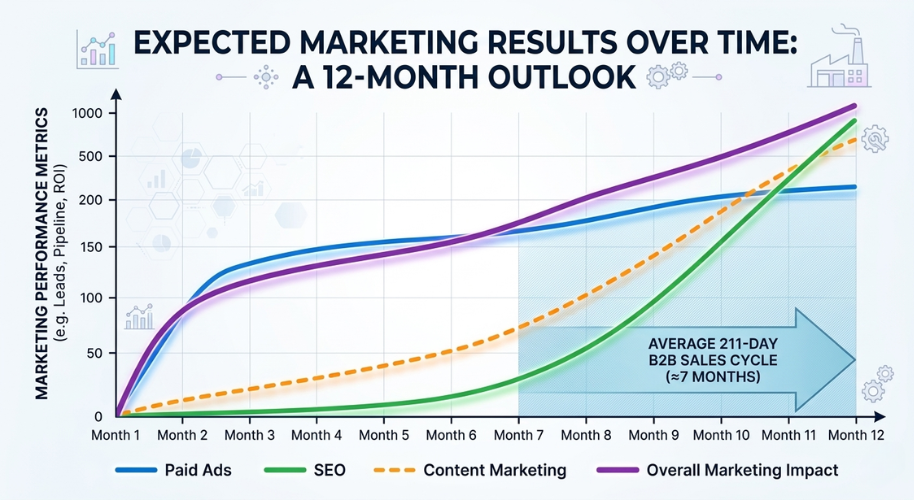
Manufacturing companies face unique challenges that generic marketing agencies simply cannot address. With B2B sales cycles averaging 211 days, manufacturers need partners who understand long-term relationship building rather than quick-win tactics. The complexity increases when you consider that manufacturing purchases often involve multiple stakeholders, from engineers and procurement managers to C-suite executives, each requiring different communication approaches.
A skilled B2B Marketing Agency understands these nuances and can navigate the technical requirements, compliance considerations, and relationship dynamics that define manufacturing sales. They recognize that selling industrial equipment differs fundamentally from selling consumer products, requiring specialized content, longer nurturing sequences, and sophisticated lead scoring models.
The digital transformation imperative has made this expertise even more valuable. 30-40% of manufacturers have increased their digital marketing spending in response to changing market dynamics post-COVID, but many lack the internal expertise to deploy these investments effectively.
Critical Red Flags: Warning Signs to Avoid
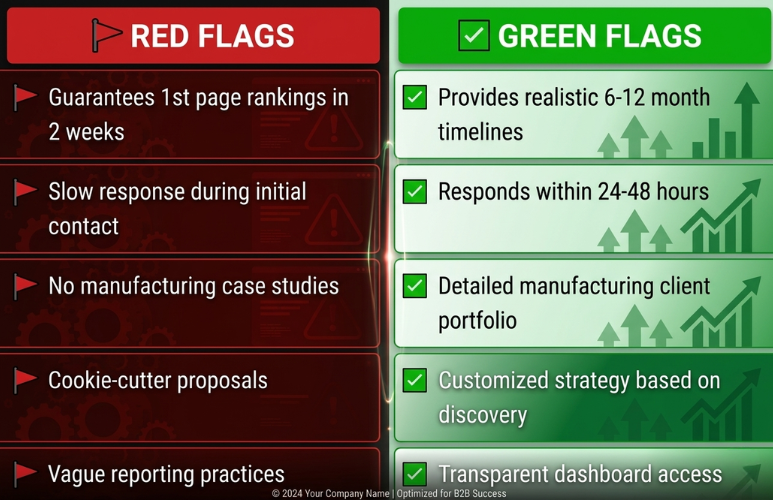
Understanding what to avoid is often as important as knowing what to look for. The research identifies five major red flags that should immediately disqualify potential agency partners.
Unrealistic Promises and Guaranteed Results
Agencies that guarantee quick results such as first-page rankings in two weeks or tripling sales in a month should be approached with extreme caution. Effective B2B marketing requires time, strategy, and continuous testing. The wrong B2B Marketing Agency choice can cost manufacturers both time and revenue when unrealistic expectations lead to rushed, ineffective campaigns.
What you should look for instead are agencies that discuss testing phases, iterative optimization, and provide case studies showing gradual, sustainable growth over quarters rather than weeks. A competent B2B Digital Marketing Agency will demonstrate proven experience with manufacturing clients and realistic timelines based on actual industry data.
Poor Communication During Initial Contact
If an agency is unresponsive during the initial contact phase, communication will likely not improve post-contract. This red flag manifests in several ways: taking more than 48 hours to respond to initial inquiries, providing vague responses that don’t address specific questions, difficulty scheduling discovery calls, or lack of a structured onboarding process explanation.
The best B2B Digital Marketing Agency partners act as extensions of your internal team, which requires excellent communication from the very first interaction. During your evaluation process, pay close attention to response times, the depth of their questions about your business, and their ability to explain complex concepts clearly.
Absence of Proven Track Record
Agencies must be able to provide case studies, testimonials, and examples of past successes with real metrics and stories. For manufacturing specifically, agencies should showcase their ability to navigate complex buyer journeys and long sales cycles. Vague references to experience without specific manufacturing client examples represent a significant warning sign.
When evaluating potential partners, ask for detailed case studies that include specific metrics, timelines, and challenges overcome. A specialized B2B Lead Generation Agency understands the long sales cycles typical in manufacturing and should be able to demonstrate how they’ve successfully managed similar engagements.
Cookie-Cutter Approaches Without Customization
Agencies that apply the same strategy to every client without considering unique business aspects should be avoided. A competent agency will ask detailed questions to understand your specific needs, target audience, competitive landscape, and business objectives before proposing any strategy.
This is particularly critical for manufacturing, where agencies that don’t demonstrate understanding of how to communicate differently to various stakeholders such as engineers, procurement managers, and C-suite executives represent a critical mismatch. Your B2B Lead Generation Agency should focus on quality leads rather than quantity alone, tailoring their approach to your specific buyer personas and sales process.
Opaque Operations and Lack of Transparency
Agencies that do not share their methods or data with clients create a dangerous lack of transparency. A trustworthy agency will educate you about their strategies and provide access to analytics and reports, ensuring you understand how your marketing efforts are performing.
Additional red flags specific to manufacturing include focus on tactics without strategic framework, lack of understanding of the manufacturing environment, inability to explain technical content accuracy strategies, and no clear process for handling complex, technical product information.
What Sets Top B2B Agencies in India Apart from the Rest
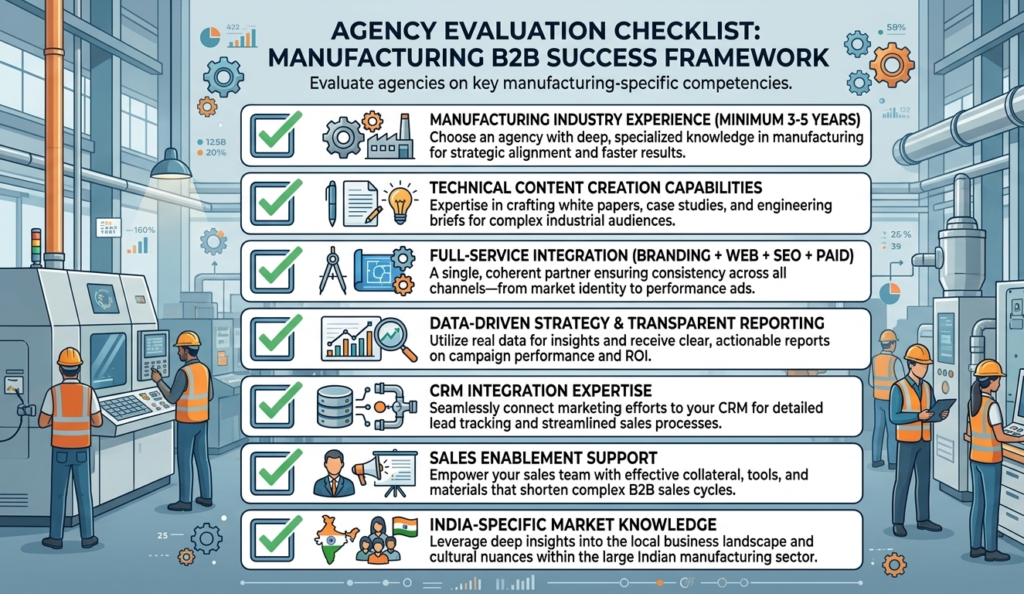
The most effective agencies distinguish themselves through several key characteristics that directly address the unique needs of Indian manufacturers.
Deep Industry Expertise and Manufacturing Experience
Agencies must have proven experience in the manufacturing sector, understanding the complexities of technical products and long sales cycles. This expertise manifests in their ability to create content that resonates with technical decision-makers, understand industry-specific vocabulary and requirements, and navigate complex, multi-stakeholder buying processes.
When evaluating the best B2B marketing agencies for manufacturers in India, look for demonstrated history of working with manufacturing clients, understanding of technical buyer personas, and familiarity with industry-specific compliance and certification requirements.
Technical Writing and Content Capabilities
The agency must produce high-quality, technical content that meets the expectations of manufacturing audiences. This includes creating data-rich case studies, technical specifications, white papers, and other materials that support the buyer’s journey.
Critical capabilities include technical accuracy in content creation, ability to translate complex engineering concepts for different audiences, experience creating content for various stages of the manufacturing buyer journey, and a portfolio of technical content examples from similar industries.
Integrated, Full-Service Offerings
Essential B2B Marketing Services Every Manufacturer Needs include a range of integrated capabilities. A suitable agency should provide services including branding, web design, content creation, SEO, and sales enablement. This integration ensures that all marketing efforts are cohesive and aligned with business goals.
Evaluate the breadth of services offered in-house versus outsourced, coordination mechanisms between different service teams, examples of integrated campaigns for manufacturing clients, and ability to align marketing with sales enablement needs.
Data-Driven Strategy and Measurement
Successful marketing in the manufacturing sector relies on measurable results. Agencies should employ data-driven strategies and provide transparent reporting to track performance and ROI. Your B2B Digital Marketing Agency should provide transparent reporting and measurable results, including sophisticated attribution modeling, CRM integration capabilities, detailed reporting processes, and understanding of manufacturing-specific KPIs.
Step-by-Step Process: How to Choose a B2B Marketing Agency in India
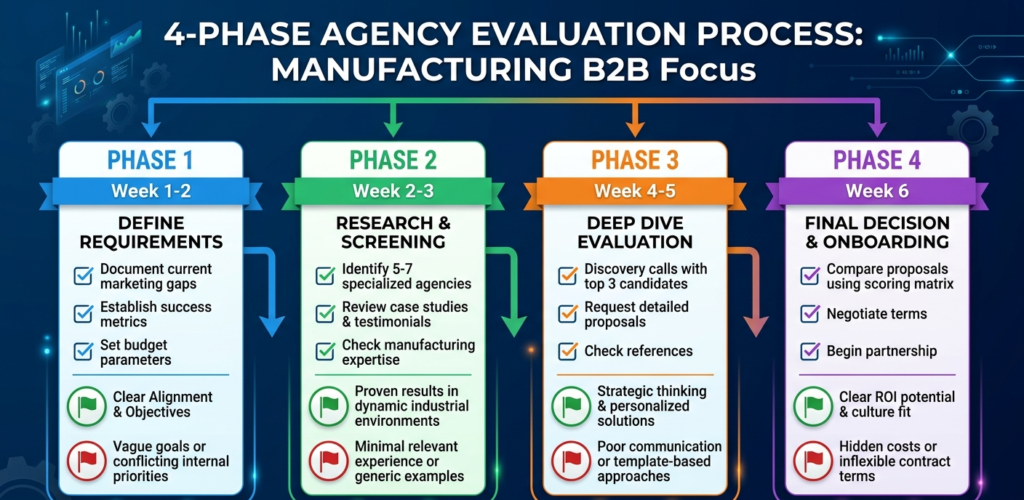
Understanding how to choose a B2B marketing agency in India requires knowledge of local market dynamics combined with global best practices. The evaluation process should be systematic and thorough.
Phase 1: Define Your Requirements and Goals
Before beginning your search, clearly define what you need from an agency partnership. Consider your current marketing maturity, specific challenges you’re facing, budget constraints, and desired outcomes. This clarity will help you identify agencies with relevant experience and capabilities.
Document your current marketing efforts, identify gaps in your strategy, and establish clear success metrics. This preparation will enable more productive conversations with potential agency partners.
Phase 2: Research and Initial Screening
Begin by researching agencies that specialize in B2B manufacturing marketing. Look for agencies with strong online presence, published case studies, and thought leadership content relevant to your industry. Create a shortlist of 5-7 agencies that meet your basic criteria.
During initial screening, evaluate their website quality, content depth, client testimonials, and team expertise. Pay attention to how they present their own marketing – agencies that can’t effectively market themselves are unlikely to succeed in marketing your business.
Phase 3: Deep Dive Evaluation
For shortlisted agencies, conduct detailed evaluations using the framework outlined in this guide. Request detailed proposals, case studies, and references. Schedule discovery calls to assess their understanding of your business and industry.
The process of how to choose a B2B marketing agency in India involves evaluating both global expertise and local understanding. Assess their knowledge of Indian market dynamics, regulatory environment, and cultural considerations that might impact your marketing strategy.
Essential Questions to Ask Potential Agency Partners
The right questions can reveal crucial insights about an agency’s capabilities and fit for your organization. Structure your evaluation around four key areas.
Manufacturing Experience and Expertise Questions
Start by validating their manufacturing experience. Ask for case studies from similar manufacturing clients, examples of how they communicate differently to various stakeholders (engineers, procurement, C-suite), and their strategy for ensuring technical content accuracy.
Understanding their approach to long sales cycles is crucial. Ask how they approach marketing for products with 6-12 month sales cycles and how they maintain engagement throughout extended buyer journeys.
Strategy and Methodology Questions
Evaluate their strategic approach by asking about their marketing framework for manufacturing clients, how they map and address different stages of the manufacturing buyer journey, their content creation process for technical products, and how they ensure alignment between branding, digital marketing, and sales enablement.
An effective B2B Lead Generation Agency will integrate seamlessly with your existing sales processes and demonstrate a clear methodology for lead qualification and nurturing.
Measurement and ROI Questions
Understanding their measurement capabilities is critical. Ask how they measure success for manufacturing clients, what attribution model they use and why, their reporting process and frequency, and how they track marketing-attributed versus marketing-influenced revenue.
India-Specific Questions
For agencies operating in India, ask about their experience with Indian B2B manufacturing companies, how they help manufacturers transition to digital marketing, their approach to regional versus national campaigns, and how they optimize marketing spend for Indian market conditions.
Why Your Manufacturing Business Needs a Specialized B2B Lead Generation Agency
Lead generation in manufacturing requires specialized expertise that goes beyond general B2B marketing knowledge. A specialized B2B Lead Generation Agency understands the long sales cycles typical in manufacturing and can design nurturing programs that maintain engagement over extended periods.
Manufacturing lead generation involves complex technical considerations, multiple decision-makers, and often significant financial investments. Generic lead generation approaches that work for software or services companies often fail in manufacturing contexts because they don’t account for the technical evaluation process, compliance requirements, and relationship-building necessary for success.
The best agencies understand that manufacturing leads require different qualification criteria, longer nurturing sequences, and more technical content to move through the sales funnel. They can design lead scoring models that account for technical engagement, create content that addresses specific manufacturing challenges, and integrate with complex sales processes involving multiple stakeholders.
ROI Measurement and Performance Tracking
Measuring marketing ROI in manufacturing requires sophisticated approaches that account for long sales cycles and complex buyer journeys. The fundamental formula for calculating B2B marketing ROI is: ROI = (Revenue Attributed to Marketing − Marketing Costs) ÷ Marketing Costs × 100.
However, execution of this formula is complex due to B2B sales cycles averaging 211 days and involving multiple stakeholders. Effective measurement requires deciding whether to track sourced revenue (deals where marketing created the first touch) or influenced revenue (deals where marketing touched the account at any point), with both metrics recommended for a complete view.
Attribution windows should match actual sales cycles, with a minimum of 90-180 days for B2B deals. For manufacturing with longer cycles, windows of 180-365 days may be more appropriate.
Key metrics to track include marketing-sourced revenue, marketing-influenced revenue, customer acquisition cost (CAC), MQL-to-SQL conversion rate, and pipeline velocity. Email marketing delivers $36-$40 per $1 spent, while SEO can achieve 700-748% ROI, making these channels particularly valuable for manufacturers with longer sales cycles.
India-Specific Considerations for Manufacturing Marketing
The Indian manufacturing landscape presents unique opportunities and challenges that require specialized agency expertise. The digital transformation imperative has accelerated significantly, with manufacturers recognizing the need for stronger online presence and digital marketing capabilities.
Many Indian manufacturers face critical branding challenges including lack of clear brand narrative, weak visual identity, fragmented marketing communication, and buyers perceiving them as interchangeable suppliers. Strategic branding partners can help overcome these challenges by creating cohesive brand identity and communication strategy.
Identifying the best B2B marketing agencies for manufacturers in India requires careful evaluation of their manufacturing client portfolio and understanding of local market dynamics. Different manufacturing segments have distinct customer profiles requiring tailored marketing strategies.
The best B2B marketing agencies for manufacturers in India combine technical expertise with industry knowledge, understanding both global best practices and local market nuances. They recognize that today’s industrial buyers in India conduct extensive online research before engaging with sales representatives, requiring robust online presence and quick response mechanisms for online inquiries.
Making Your Final Decision
After completing your evaluation process, synthesize your findings to make an informed decision. Consider not just the agency’s capabilities, but also cultural fit, communication style, and long-term partnership potential.
The right agency should demonstrate clear understanding of your industry, provide realistic timelines and expectations, offer transparent pricing and reporting, and show genuine enthusiasm for your business challenges. They should act as strategic partners rather than just service providers, bringing insights and recommendations that go beyond basic execution.
Remember that the cheapest option is rarely the best value, especially in B2B manufacturing marketing where the cost of poor results far exceeds the savings from lower fees. Focus on finding an agency that can deliver measurable results and grow with your business over time.
Your Next Steps
Choosing the right B2B Marketing Agency is a critical decision that will impact your business growth for years to come. Start by using the frameworks and questions outlined in this guide to evaluate potential partners systematically.
Begin your search by identifying 5-7 agencies that specialize in manufacturing marketing and have strong track records with similar clients. Use the red flags section to quickly eliminate unsuitable candidates, then apply the detailed evaluation criteria to assess remaining options.
Schedule discovery calls with your top candidates, ask the strategic questions provided in this guide, and request detailed proposals that address your specific challenges and goals. Take time to check references and review case studies carefully.
The investment in finding the right agency partner will pay dividends through improved marketing performance, better lead quality, and ultimately, increased revenue growth for your manufacturing business.
Frequently Asked Questions
For paid advertising, expect initial results within 1-3 months. For SEO, content marketing, and account-based strategies, plan for 6-12 months. This timeline is realistic given that B2B sales cycles average 211 days. Any agency promising dramatic results in weeks should be viewed with skepticism.
Specialized B2B agencies understand how to communicate differently to various stakeholders such as engineers, procurement managers, and C-suite executives. They create technically accurate content, navigate long sales cycles, and handle complex buying committees. General agencies typically apply consumer marketing tactics that fall flat in B2B manufacturing contexts.
Use this formula: ROI = (Revenue Attributed to Marketing − Marketing Costs) ÷ Marketing Costs × 100. Track both marketing-sourced revenue (first touch) and marketing-influenced revenue (any touch). Set attribution windows of 180-365 days for manufacturing. Monitor marketing-attributed revenue, customer acquisition cost, MQL-to-SQL conversion rates, and pipeline velocity.
Watch for: 1) Guaranteed quick results like first-page rankings in weeks, 2) Poor communication during initial contact, 3) No proven track record or case studies, 4) Cookie-cutter approaches without customization, and 5) Opaque operations without transparent reporting.
Local Indian agencies understand market dynamics, cultural nuances, and offer cost-effective solutions. 70% of B2B clients now initiate their buying process online, and 30-40% of manufacturers increased digital spending post-COVID. However, expertise and track record matter more than location—prioritize manufacturing experience regardless of geography.
Monthly retainers range from ₹50,000 for basic services to ₹5,00,000+ for enterprise partnerships. Email marketing delivers $36-$40 per $1 spent, while SEO achieves 700-748% ROI. Focus on ROI potential rather than cheapest option—poor results cost far more than savings from lower fees.
Ask for manufacturing case studies, examples of stakeholder-specific communication (engineers, procurement, C-suite), content creation process for technical products, measurement approach for manufacturing clients, attribution models used, and experience with Indian B2B manufacturers.
Extremely important. Different manufacturing segments have distinct customer profiles requiring tailored strategies. Agencies must understand your buyer personas, technical requirements, regulatory environment, and industry-specific vocabulary. Generic approaches that work for software or services often fail in manufacturing contexts.
Quality agencies align marketing with sales enablement by creating custom playbooks, sales collateral, and pitch decks. They should integrate marketing automation with your CRM for closed-loop reporting connecting marketing to closed deals. This ensures seamless lead transition from marketing to sales.
Ask agencies to map your typical buyer journey and explain how they’d address each stakeholder’s needs. They should demonstrate experience with account-based marketing and multi-touch nurturing campaigns. Request examples of how they’ve handled complex buying committees with multiple decision-makers in past manufacturing engagements.