

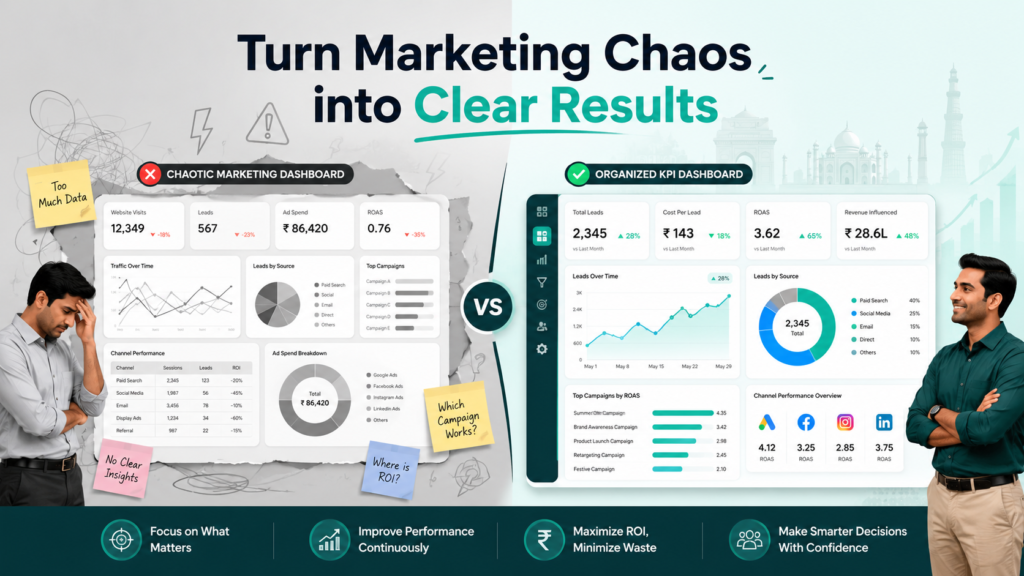
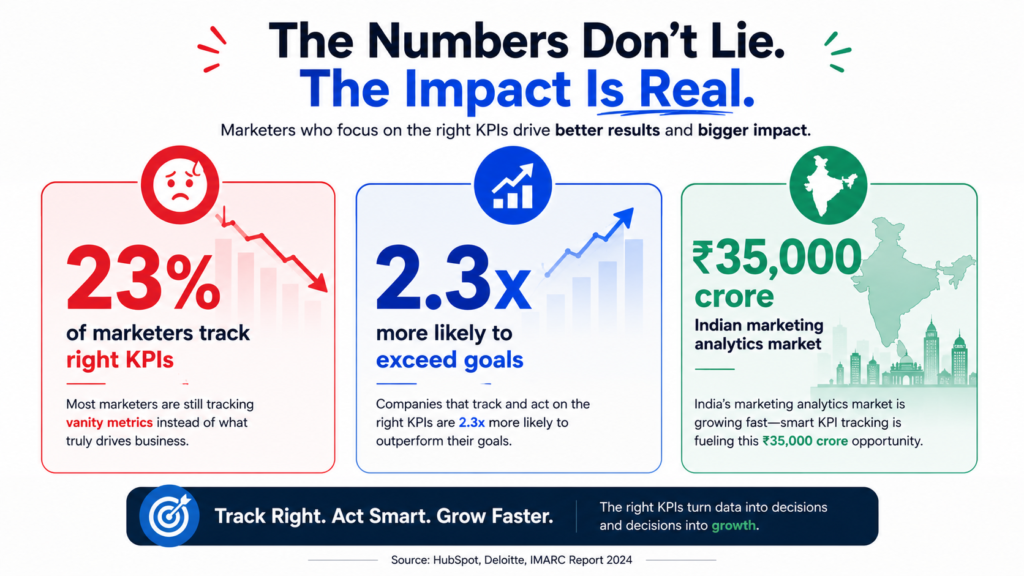
Here’s a startling reality: only 23% of marketers feel confident that they track the right KPIs. This means three out of four marketing professionals are essentially flying blind, making decisions based on metrics that don’t actually reflect business performance. In India’s rapidly growing digital landscape, where the performance marketing industry has reached over ₹35,000 crore in 2025, this gap between data collection and meaningful measurement can make or break your marketing success.
The difference between thriving businesses and struggling ones often comes down to one critical factor: understanding what to measure and why it matters. Key Performance Indicators serve as the vital signs of your digital marketing efforts, connecting every campaign, every rupee spent, and every strategy to actual business outcomes.
What Are Key Performance Indicators and Why They Matter
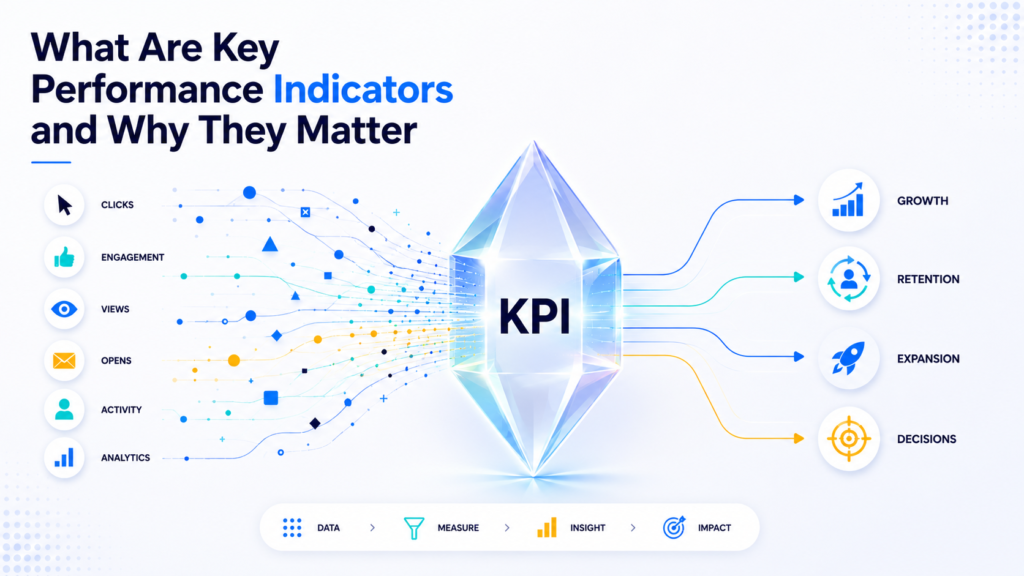
A Key Performance Indicator (KPI) is a quantifiable measure used to evaluate how effectively a company is achieving its core business objectives. While a basic metric might track simple data like website clicks or social media likes, a KPI is distinct because it is directly tied to a strategic goal, such as revenue growth or customer retention. It serves as a vital diagnostic tool, transforming raw data into actionable insights that tell you whether your current strategy is actually working.
The true value of a KPI lies in its ability to guide decision-making and ensure organizational alignment. Instead of relying on intuition, leaders use these indicators as a compass to track progress and identify performance gaps before they become major problems. When every team understands which KPIs move the needle, it creates a culture of accountability and focus. Ultimately, KPIs distill complex business operations into a clear roadmap, allowing you to prioritize the activities that generate the most significant return.
Performance Advertising: Matching Metrics to Your Growth Stage
In paid advertising – whether through Google Ads (Search) or Meta Ads (Social) – the metrics you prioritize should shift based on where your brand currently stands. While some marketers categorize reach-based metrics as “Vanity,” for established brands, these are often vital Brand Awareness Metrics that drive long-term market dominance.
The Metrics Spectrum: Awareness vs. Conversion
Instead of labeling metrics as “good” or “bad,” it is more effective to categorize them by your current business objective:
- Brand Awareness Metrics (The “Equity” Focus): Impressions, Reach, and Share of Voice. These are essential for market leaders or new product launches. If you have the budget and infrastructure to handle high-volume interest, these metrics are critical for maintaining authority and preventing competitors from stealing your market share.
- Performance Metrics (The “Efficiency” Focus): Conversion Rate, Cost Per Acquisition (CPA), and Return on Ad Spend (ROAS). These are the lifeblood of growth-stage businesses or those focused on maximizing immediate ROI from their ad spend.
The Anatomy of an Ad: Aligning Strategy with Goals
Advertising effectiveness is defined by how well the ad meets its intended objective
| Feature | Awareness Ad | Performance Ad |
|---|---|---|
| Objective | Building brand recall and recognition | Driving immediate action or purchase |
| Focus | Storytelling, brand values, and emotional connection | Product solutions, offers, and benefits |
| Call to Action (CTA) | Subtle CTAs such as “Learn More” or “Watch Now” | Direct CTAs such as “Shop Now” or “Get a Free Consultation” |
| Data Usage | Optimized for CPM (Cost per 1,000 Impressions) and reach | Optimized for ROAS (Return on Ad Spend) and CPA (Cost Per Acquisition) |
| Outcome | Increased brand awareness, positive sentiment, and stronger market presence | Higher conversion volume, lead generation, and immediate revenue growth |
When running Google Ads, your strategy changes based on these goals. If you are a market leader, you might bid on broad category keywords to dominate search results (Awareness). If you are a challenger brand, you focus on high-intent long-tail keywords that capture customers ready to buy right now (Performance).
Similarly, with Meta Ads, a high-budget brand might use video storytelling to reinforce its image across millions of users, whereas a performance-focused business will use A/B tested catalog ads to drive specific, trackable sales. A “good” ad is simply one that excels at the specific goal you have set for that campaign, whether that is building a legacy or closing a sale.
Essential KPIs for Digital Marketing Success
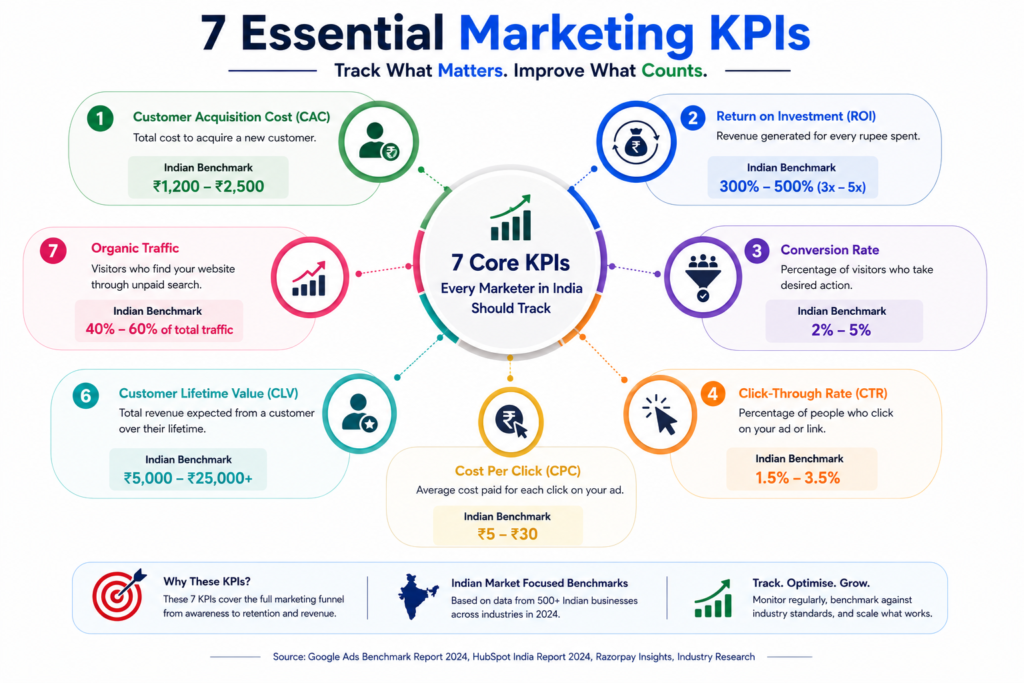
The seven core marketing KPIs form the foundation of effective digital marketing measurement. Each serves a specific purpose in understanding your marketing performance:
Customer Acquisition Cost (CAC) tells you exactly how much you’re investing to convert leads into paying customers. In India’s competitive market, understanding CAC is crucial for optimizing marketing spend. For Google Search Ads in India, B2B services typically see costs per lead ranging from ₹200 to ₹2,000, while D2C e-commerce brands experience cost per acquisition between ₹300 to ₹800.
Return on Investment (ROI) provides the ultimate measure of marketing effectiveness. When Dove implemented their Real Beauty campaign with purpose-driven marketing, they achieved a remarkable 700% increase in brand sales over ten years. This demonstrates how the right KPI focus can drive extraordinary long-term results.
Conversion Rate measures how effectively your marketing efforts turn prospects into customers. Nearly 50% of marketers prioritize conversion rate optimization (CRO) as a key technique, and for good reason-it directly impacts revenue without requiring additional traffic investment.
Social media engagement becomes particularly important in India, where Facebook has over 400 million users and Instagram has 230 million users. High engagement rates suggest that content is relevant and valuable, fostering community and trust among followers.
How to Define KPI That Actually Drive Results
Learning how to define KPI properly requires following the SMART framework. Your KPIs must be Specific, Measurable, Achievable, Relevant, and Time-bound. This isn’t just marketing theory-it’s the difference between tracking vanity metrics and measuring business impact.
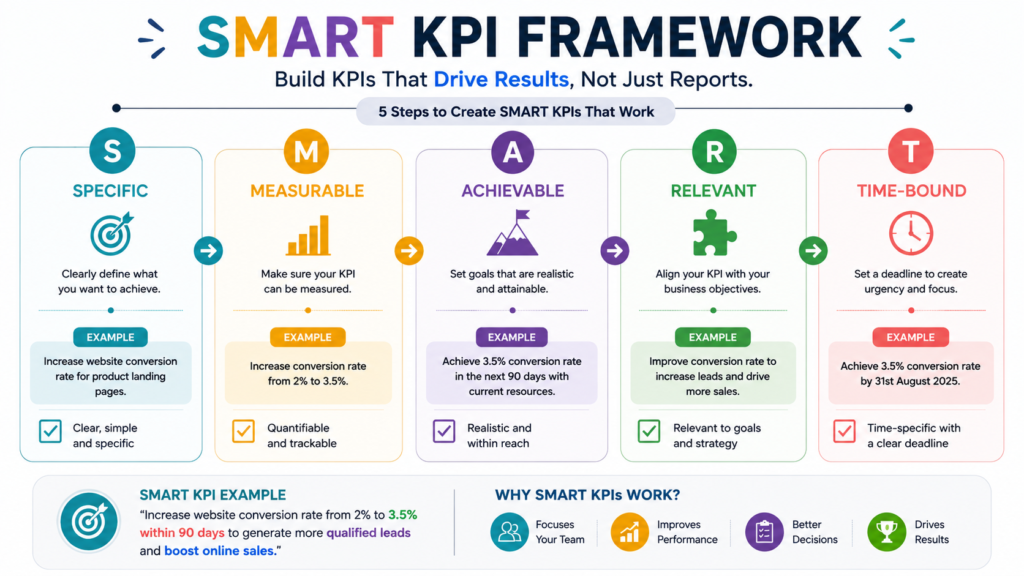
The key is aligning your KPIs with customer journey stages. Awareness stage KPIs focus on metrics like website traffic and impressions. Consideration stage metrics include time spent on website and social media interactions. Decision stage KPIs center on conversion rates and sales revenue.
Consider Nike’s approach: their “You Can’t Stop Us” campaign utilized personalized marketing through mobile apps, resulting in an 80% year-over-year increase in app engagement and significant boost in repeat purchases. They didn’t just track downloads-they measured engagement and repeat behavior, true indicators of marketing success.
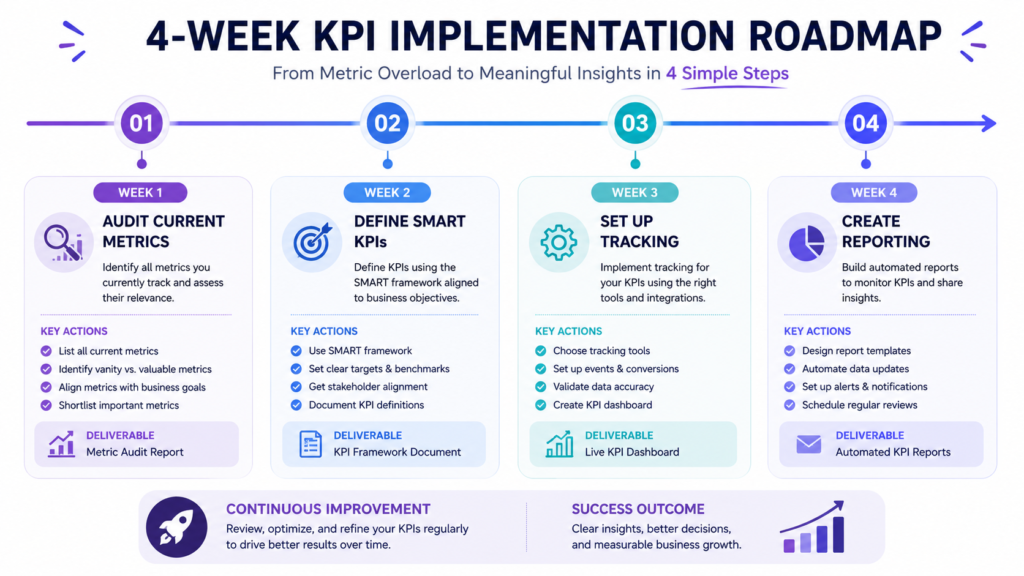
The most successful approach involves understanding that there’s no universal solution in digital marketing, so the KPIs that work for one company won’t necessarily be right for another. Your KPI selection must reflect your specific business context, industry, and growth stage.
Start by identifying your primary business objectives, then work backward to determine which metrics directly influence those outcomes. Focus on fewer, more meaningful KPIs rather than attempting to track everything. Remember, 56% of marketers find it easier to improve conversion rates now compared to a decade ago, indicating that the right tools and strategies can make KPI management more effective than ever.